FINANCIAR
The US AI giants' correction — why Alphabet lost 12.6% in one day and what it means for Romanian investors

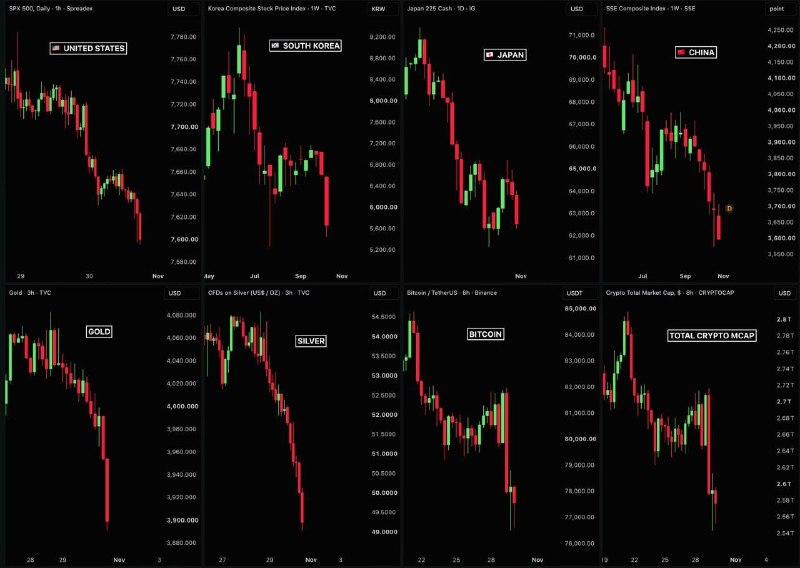
Wall Street has stopped paying any price for artificial intelligence: the giants investing more than they earn lost hundreds of billions, while the broad index was left almost untouched.
The analysis follows four threads: what happened to prices, why, what olivLaw's data show about these firms and what happened historically after similar drops. At the end we give three scenarios for the S&P 500 index, the forecast table and the thresholds at which we consider ourselves wrong.
The testable thesis: the correction is a repricing of the return on AI investment, not the start of a general market decline. If the SPY fund, which tracks the S&P 500 index, closes on 29 January 2027 below $700, that is more than 7% below its 30 October level, the thesis is wrong.
What happened to prices
Alphabet published its third-quarter results on the evening of 28 October. The next day, the share fell from $324.89 to $283.82, or 12.6%. According to TechCrunch, it was the worst day in the company's history and wiped about $500 billion off its market value. On Friday, 30 October, it lost another 1.4%, and it now stands 30.5% below its 13 May high.
The fall did not stop at Alphabet. In October, Meta lost 15.2% and is 20.9% below its September high. AMD fell 10.9% on 30 October alone and is 22.3% below its 6 October record. Also on Friday, Nvidia lost 4.2% and Broadcom 5.5%. By contrast, Microsoft ended the month up 1.8% and Apple up 3.5%.
| Firm | 30 October | October | From one-year high |
|---|---|---|---|
| Alphabet (Google) | −1.4% | −18.7% | −30.5% |
| Meta | −1.5% | −15.2% | −20.9% |
| AMD | −10.9% | −17.5% | −22.3% |
| Nvidia | −4.2% | −10.4% | −14.5% |
| Microsoft | −1.6% | +1.8% | −4.0% |
| Apple | −1.2% | +3.5% | −1.2% |
| S&P 500 (SPY fund) | −1.8% | −0.9% | −3.0% |
The table shows where the difference lies. The broad index fell less than 1% in October, while a few large firms lost between 10% and 19%. This is a correction concentrated on the firms spending most on artificial intelligence and on their chip suppliers, not a general sell-off.
Why: investment outruns the cash generated
Alphabet's results were not weak in themselves. Revenue grew 25% to $127.6 billion, and Google Cloud doubled its sales to $30.7 billion, according to AI Weekly. The problem was elsewhere. The company invested $51.4 billion in a single quarter, against $24 billion a year earlier, more than the $42.3 billion generated by its operations. Free cash flow came out negative, at minus $9.1 billion.
Alphabet also announced that investment will exceed $300 billion in 2027. Earnings per share of $2.12 were well below the roughly $3 expected, largely because of an $8.7 billion loss on its stakes in other companies, according to XTB. Growth in search revenue slowed to 12%, the weakest pace in five quarters.
Meta has the same problem. In the third quarter it invested more than it generated, with free cash flow of minus $2.1 billion, and it set its 2026 investment at between $135 and $145 billion, according to Let’s Data Science. Amazon, with AWS sales up 39%, expects about $220 billion of investment this year and has negative free cash flow over the past 12 months.
Microsoft shows what the market now rewards. The company invested $45.2 billion in the quarter, below the estimated $50 billion, and had positive free cash flow of $18.6 billion, according to CNBC. The share lost less than 2% in the two days after its results. Investors are not punishing investment in AI, but investment that does not yet pay for itself.
Money is getting more expensive to borrow. Microsoft, Alphabet, Amazon, Meta and Oracle raised $326 billion of debt in 2026, three times as much as last year. The Federal Reserve held its rate between 3.75% and 4% on 28 October, but two members voted for a hike, according to Admiral Markets. Inflation was 3.7% in September, and the 10-year Treasury yield reached about 5%. Markets give a new rate rise on 9 December a chance of about 85%.
What is documented and what is our conclusion: the results figures come from the financial press that quoted the companies' releases, and the prices from olivLaw's data. The link between negative free cash flow and the fall in the shares is our interpretation, supported by the fact that Microsoft, the only one with investment below plan and positive cash flow, held up. It is not a proven relationship.
What olivLaw's data show
We calculated, from the reports filed with the US market regulator (SEC) and from 30 October prices, how much each firm costs relative to the profit from its core business. The measure used is enterprise value divided by operating profit over the past 12 months: the lower it is, the cheaper the firm.
| Firm | Value / operating profit | Operating margin | Investment as share of revenue | Free cash flow relative to market value |
|---|---|---|---|---|
| Alphabet | 22.5 | 33% | 34% | 0.6% |
| Meta | 20.8 | 33% | 43% | 1.8% |
| Microsoft | 23.8 | 47% | 39% | 1.5% |
| Nvidia | 25.0 | 65% | 2% | 2.6% |
| Apple | 32.7 | 33% | 2% | 2.7% |
After the fall, Alphabet and Meta are the cheapest of the giants relative to operating profit, with margins of 33%. But the money left after investment is almost zero compared with the share price. Their value now depends almost entirely on what the AI investment will bring in. Nvidia is in the opposite position: it sells the chips the others buy and has large free cash flow.
We then checked what happened historically after large drops on results day, across 135,395 quarters reported by US firms between 2017 and 2026. In the 8,324 cases with a fall of more than 10% on results day, the share stayed on average 1.2% behind the market over the next three months, and the median was minus 4.2%. Only 42% of these firms beat the market. Since 2023, the average has been minus 2.2%.
The conclusion is that there is no systematic rebound after such drops; rather, the decline continues slightly for one to three months. The important caveat is that the sample is dominated by small firms, and for very large firms the effect is less certain.
What it means for an investor in Romania
Most Romanians who invest in the US market do so through a fund that tracks an index, bought in euros on a European exchange, such as those on the S&P 500 or MSCI World. For them, October's correction means an index 3% below its high. Anyone who buys the same amount monthly now gets slightly more units. The data above offer no reason to stop or double contributions.
Anyone wanting to buy the fallen shares directly must choose between a firm that is cheap on profit but has no spare cash, such as Alphabet or Meta, and one that is expensive but solid, such as Microsoft. The history above suggests that buying in stages over a few months costs no return on average. The concrete markers for judging the investment are fourth-quarter free cash flow and the pace of Google search, not the price on a given day.
Two details matter for a Romanian. Prices are in dollars, so the euro-dollar exchange rate adds or subtracts a few percentage points. Gains realised through a foreign broker are taxed at 16% in 2026, and the return is filed annually. Nothing in this analysis is investment advice.
Three scenarios for the S&P 500
The variable is the closing price of the SPY fund on 29 January 2027, against $755.72 on 30 October 2026. The three scenarios cover all cases and are mutually exclusive. The probabilities start from the index's historical volatility, widened for the risk calendar in November and December.
- A · Below $700 (15%). The correction spreads to the whole market: the Federal Reserve raises rates, inflation stays close to 4% because of energy, and AI investment continues without matching revenue. In this scenario, our thesis is wrong.
- B · Between $700 and $790 (55%). Slow digestion: the AI giants stay under pressure until the February results, but the rest of the market offsets them. This is the base scenario.
- C · Above $790 (30%). The investment starts to pay off: cloud and AI-driven advertising grow, free cash flow returns towards zero, and rates stabilise. The index makes a new high.
The risk calendar: 3 November, AMD's results; 6 November, US jobs data; 10 November, inflation; 9 December, the Federal Reserve decision; early February, fourth-quarter results from Alphabet, Meta, Microsoft and Amazon.
Forecast table
| Forecast | Horizon | Probability | How it is checked | Verification source |
|---|---|---|---|---|
| Scenario A: the SPY fund closes below $700 on 29 January 2027 | 29.01.2027 | 10–20% | The SPY fund's closing price on that day | finance.yahoo.com, nyse.com |
| Scenario B: the SPY fund closes between $700 and $790 on 29 January 2027 | 29.01.2027 | 50–60% | The same closing price | finance.yahoo.com, nyse.com |
| Scenario C: the SPY fund closes at $790 or more on 29 January 2027 | 29.01.2027 | 25–35% | The same closing price | finance.yahoo.com, nyse.com |
| The Federal Reserve raises its policy rate at the 9 December 2026 meeting | 09.12.2026 | 75–85% | The Federal Reserve statement after the meeting | federalreserve.gov |
When we consider the analysis wrong
- The concentrated-correction thesis is wrong if the SPY fund closes below $700 on 29 January 2027: then it was not a repricing of the AI giants but the start of a general decline.
- The cash-flow reading must be revised if Alphabet reports positive free cash flow for the fourth quarter and the share still does not recover: then the market fears something else, for example competition in search.
- The historical reading must be revised if Alphabet and Meta clearly beat the index over the next three months: then very large firms do not follow the pattern of post-results drops.
Main sources: cracks in the AI spending boom (TechCrunch), Alphabet's results (AI Weekly), the reaction to Alphabet's results (XTB), Microsoft and Google investment (CNBC), Meta's 2026 investment (Let’s Data Science), the Federal Reserve decision of 28 October (Admiral Markets), the chip sell-off of 22 October (TIKR). Prices, SEC filings and the study of post-results drops are from olivLaw's data.