GEOPOLITICA
What the Abu Dhabi Round Reveals About the Limits of American Mediation in the War in Ukraine
1. What happened in Abu Dhabi and who is at the table
The talks opened on Tuesday, November 10, in Abu Dhabi, the capital of the United Arab Emirates (United Arab Emirates), the host country.
According to AP reporting, the two-day session was to focus on security guarantees, according to the White House. Meduza notes that the agenda included both territorial issues and security guarantees, on November 10–11.
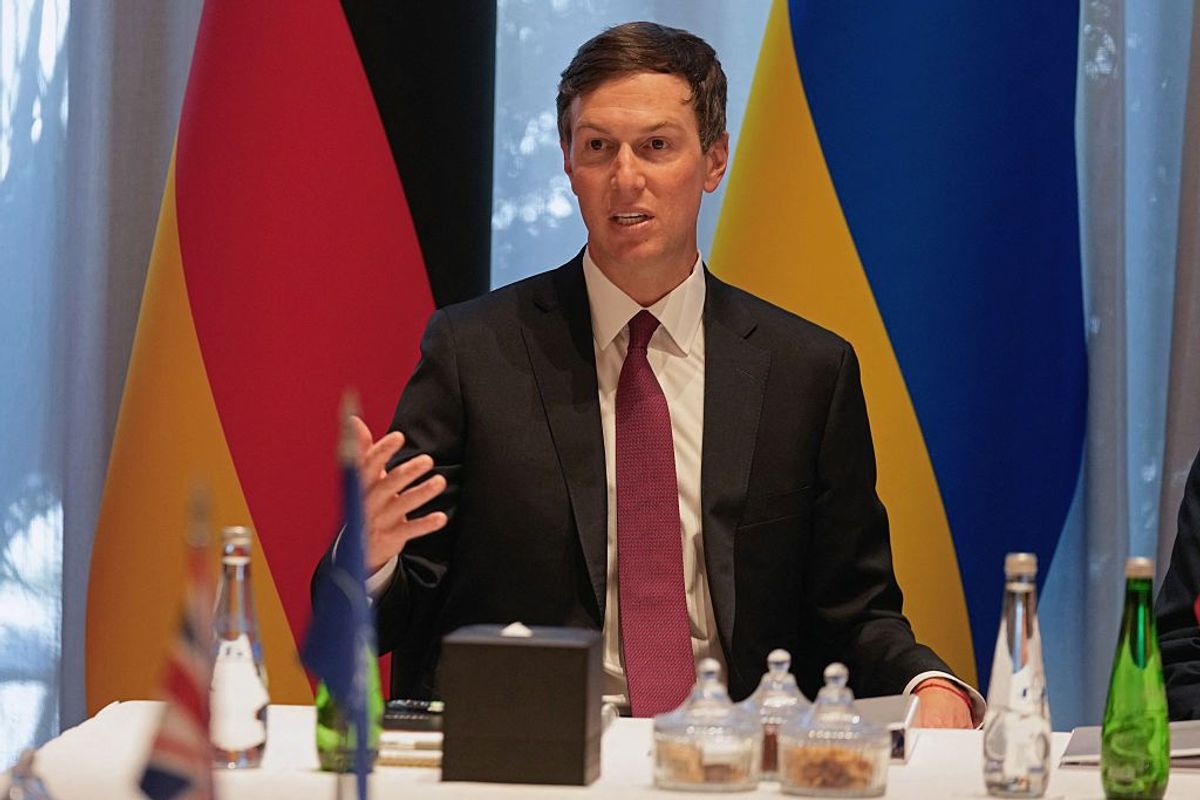
The United States (United States) is acting as mediator, through two presidential envoys. Jared Kushner, son-in-law of President Donald Trump and his envoy, wrote on X that he is working together with Steve Witkoff, the other American envoy, toward a "negotiated solution" for a lasting peace and a Ukraine that is "sovereign, secure and prosperous." Before the trilateral session, Witkoff held a separate meeting with representatives of Ukraine and Europe.
The Ukrainian delegation is led by Rustem Umerov, head of Ukraine's Foreign Intelligence Service, who also attended previous rounds. According to Anadolu, Umerov said he has a mandate from President Zelensky to discuss all issues related to ending the war. The delegation also includes Kyrylo Budanov, head of the Presidential Administration, his deputy Serhii Kyslytsya, and the leader of the governing parliamentary faction, Davyd Arakhamia.
The Russian delegation is led by Vladimir Medinsky, a presidential adviser who has negotiated for Moscow since Istanbul in March 2022. Meduza, citing the publication Agentstvo, writes that the Russian delegation has five members and six experts, four of whom are participating for the first time. The Emirati Foreign Minister, Sheikh Abdullah bin Zayed Al Nahyan, welcomed the participants, without a declared mediating role.
The format is therefore trilateral, with no European negotiators at the table, but with Europeans consulted beforehand.
2. What the United States gains and risks
For Washington, Abu Dhabi is primarily a test of initiative. Kushner stated that the American team has had near-daily conversations with both sides and has identified where the differences remain, and has "some ideas" for narrowing them. The statement should be read as a positioning signal by the mediator, not as evidence that the differences are reducible. The second element is the expansion of the mandate.
Kushner said the goal is not only ending the war but a new security framework among Ukraine, Russia, and Europe. According to Meduza, citing the Financial Times, an earlier Kushner statement about a new European security system was received in Europe as a "complete surprise". This creates a tension for American institutions. A renegotiated European security framework directly touches US commitments within NATO, not only the Russia–Ukraine relationship.
Meduza, citing TASS, reports that the Supreme Allied Commander Europe, Alexus Grynkewich, was also reportedly at the negotiating table; this information comes from a Russian state source and is not confirmed in the other available sources. The American political calendar adds a layer of context, not causation. The round comes one week after the midterm congressional elections of November 3. The available sources do not establish any link between the election results and the timing of the negotiations, and no such link can be asserted.
Any claim about the round's effect on oil, gas, or yields would be speculative in the absence of such data. What can be said is that an agreement would reduce a geopolitical risk premium, while a collapse could raise it; the magnitude remains unclear.
3. The mechanism: why declared positions block an armistice
The causal chain starts from the incompatibility of demands. According to The Hindu, Vladimir Putin demands that Ukraine withdraw its troops from Donetsk, Luhansk, Zaporizhzhia and Kherson, regions illegally annexed in September 2022 but not fully conquered. He also demands renunciation of NATO membership and strict limits on the Ukrainian army.
The second link is sequencing. Moscow refuses a general ceasefire before a comprehensive agreement, arguing that it would allow the Ukrainian army to regroup. Kyiv argues the opposite: an immediate ceasefire is the first step, and territorial questions can only be settled in a direct Putin–Zelensky meeting.
The third link is pressure on the battlefield as a bargaining lever. On November 9, the day before the opening, a Russian attack on Odesa killed three people and set fire to a food warehouse for schools, according to the governor of the Odesa region, Oleh Kiper. On the night before the talks, Russia launched 162 drones and a ballistic missile, according to the Ukrainian Air Force, while the Russian Ministry of Defense reported 155 Ukrainian drones shot down.
The simultaneity is a fact; intent is not directly documented. Euromaidan Press notes that the attacks appear to match what Zelensky called an effort to squeeze Ukraine before negotiations, but this is one party's interpretation. The data show that the strikes continued, not that they were calibrated to the diplomatic calendar.
The fourth link is the widening of the agenda. A source in the Russian delegation told Reuters, cited by Meduza, that the Ukrainian settlement is "only one aspect," subordinate to creating a "comprehensive and indivisible" security architecture for the entire continent. The European Union's reaction, through Kaja Kallas, was that the architecture already exists, and the problem is that Russia is violating the treaties that underpin it.
The likely effect of these four links is a process that continues but does not converge quickly.
Counter-hypothesis: discrete convergence beneath rigid rhetoric
The competing hypothesis deserves serious consideration. Public positions may be maximalist precisely because real negotiation is taking place discreetly; Kushner asserts that the differences have already been mapped, and Umerov said preparation has taken nearly a year, intensively over the last two months. The presence of General Staff military personnel in the Russian delegation may suggest technical discussions about lines of separation.
The arguments against the counter-hypothesis are, however, stronger on the available sources. According to AP, three previous rounds produced no significant breakthrough, and the two armies are largely locked along the front line. A static front reduces the cost of continuing the war for both sides and does not create the pressure that forces territorial concessions.
The weight of the evidence favors the blockage hypothesis, but does not prove it.
4. Mistrust as a negotiating variable
An unusual element of this round is the composition of the delegations. According to Meduza, among the Russian experts is Dmitry Minaev, head of the FSB's Counterintelligence Operations Department. Ukrainian sources cited by the Wall Street Journal claim that Minaev and his department were behind a failed attempt to assassinate Kyrylo Budanov, who is now in the Ukrainian delegation.
The claim remains an accusation by one party, conveyed through anonymous sources, with no known date for the alleged attempt. It cannot be treated as established fact. Its analytical relevance, however, does not depend on its veracity: the mere presence of a person accused by an adversary signals the level of mistrust at the table.
From the perspective of Jervis, such signals can be read differently by each side. Moscow may present the delegation as "larger and more professional," as Medinsky put it; Kyiv may read it as a provocation. An American mediator who does not control the composition of the delegations cannot eliminate this asymmetry of perception.
Meduza further notes that the department led by Minaev participated in detaining American citizens in Russia, including WSJ correspondent Evan Gershkovich, released in the August 1, 2024 prisoner exchange. This history links the negotiation to a bilateral US–Russia channel, that of prisoner exchanges, which functioned even during periods of political deadlock.
Mistrust does not halt discussions, but it raises the threshold for any verifiable commitment.
5. Europe, NATO and the consequences for the eastern flank
Europeans are not at the trilateral table, but they entered the process before it. Ukraine first met with representatives of the United Kingdom, France, Germany, Italy, NATO and the European Commission, according to the Kyiv Independent and AP. Witkoff later stated he wants to extend the process to multilateral discussions with European partners. For the United States, this configuration has two possible readings. First: Washington uses European consultation to build credible security guarantees it would not provide alone.
Second: Washington remains the decision-maker on format, and Europeans are informed rather than co-negotiators. The sources do not permit a firm choice between the two. Romania is directly touched only insofar as the negotiation reopens the European security architecture. Any framework that included limits on NATO presence near Russia would also concern the eastern flank, including the Black Sea. The more immediate channel is strikes on civilian infrastructure in the Odesa region, which lies near the Danube.
Euromaidan Press reports that a logistics company in the region was hit for the third time. The sources do not establish any effect on Romanian trade flows.
6. What comes next: scenarios and verifiable predictions
The first day lasted, according to Russian state press cited by Anadolu, approximately four and a half hours, with resumption scheduled for Wednesday morning. Duration says nothing about content. The scenarios below are mutually exclusive over a three-month horizon.
Dominant scenario: talks continue without breakthrough (45–60%)
Driver: both sides have an interest in remaining in the US-mediated process so as not to be perceived as the party blocking peace. Constraint: territorial demands and the sequencing dispute remain unchanged. Consequence: further rounds, possibly with European expansion, while strikes continue; Washington retains initiative without tangible result. Indicator: official announcement of a new round without a jointly signed document.
Plausible scenario: framework agreement and partial ceasefire (15–25%)
Driver: the American "bridge" ideas Kushner invokes, possibly on energy infrastructure or prisoner exchanges. Constraint: Moscow's declared refusal of a general ceasefire. Consequence: a sectoral armistice, easier for Russia to accept than a general one. Indicator: joint communiqué naming a specific domain of ceasefire.
Tail scenario: collapse of talks and escalation (20–30%)
Driver: Putin's warning that Russia will achieve its objectives by force if Kyiv refuses the conditions. Constraint: the political cost to Moscow of abandoning a US-mediated format. Consequence: intensification of strikes, with risk to energy and logistics infrastructure on the Black Sea. Indicator: announced withdrawal of a delegation or formal suspension of rounds.
| Prediction | Horizon | Probability | How to verify | Verification source |
|---|---|---|---|---|
| No officially announced general ceasefire accepted by Russia and Ukraine | 31.01.2027 | over two in three | Absence of a joint announcement of a general ceasefire | Communiqués of the Ukrainian Presidency, the Kremlin and the White House |
| At least one new trilateral Russia–Ukraine–US round is announced | 31.01.2027 | dominant scenario (55–70%) | Official announcement of the date and venue of a new round | Communiqués of the White House, State Department and Ukrainian Presidency |
| A partial ceasefire in a specified domain (e.g., energy) is announced | 28.02.2027 | 15–25% | Joint communiqué or concordant statements from both sides | Communiqués of the Kremlin and the Ukrainian Presidency |
| European representatives officially participate at the table of a round, not only in preliminary consultations | 31.03.2027 | 20–35% | Official list of delegations published | Communiqués of the European Commission and the State Department |
| Russia launches more than 162 drones in a single night, the level reported on the eve of the round | 31.01.2027 | over half | Daily report of the Ukrainian Air Force | Air Force of Ukraine (official channel) |
Method, definitions and figures
The analysis uses exclusively figures from the press reports indicated inline, not official statistical series. "Trilateral round" designates meetings in which the Russian, Ukrainian and US delegations participate simultaneously; bilateral Ukraine–Europe or US–Ukraine consultations on the same day are not included. The mention of "the first in February" comes from AP and The Hindu; Anadolu specifies that the previous round took place in Geneva.
The drone figures (162 launched by Russia, 155 shot down by Russia) are reports from belligerent parties and are not comparable with each other: one measures launches, the other declared interceptions, over different territories. The duration of the first day, approximately 4.5 hours, comes from Russian state press, via Anadolu. The composition of the Russian delegation, five members and six experts, comes from Agentstvo, via Meduza.
The scenario and prediction probabilities derive from an internal estimate initially expressed as point values and have been transposed here into intervals of at least 10 percentage points or into verbal categories; they are not statistically calibrated against a track record of predictions and should be read as ordinal analytical judgments, not frequencies. The 162-drone threshold in the table is the figure reported for a single night and is not an average.
The sources do not provide market, budgetary or energy data directly linked to the negotiations; any comparison of this kind is absent from the article, not estimated.
Limitations of the analysis
The analysis cannot establish the actual content of the discussions, since the available sources cover the opening and public statements, not the concrete proposals placed on the table. The accusations concerning Dmitry Minaev come from anonymous Ukrainian sources cited by the press and have not been independently verified, and the presence of the Supreme Allied Commander at the table rests only on TASS. The diagnosis of blockage would be invalidated by a joint communiqué establishing a ceasefire or by a public shift in Moscow's position on the sequencing of armistice and final agreement. The most fragile element is the assumption that public positions reflect real negotiating positions. A reassessment is needed upon announcement of the next round or, in its absence, on January 31, 2027.